
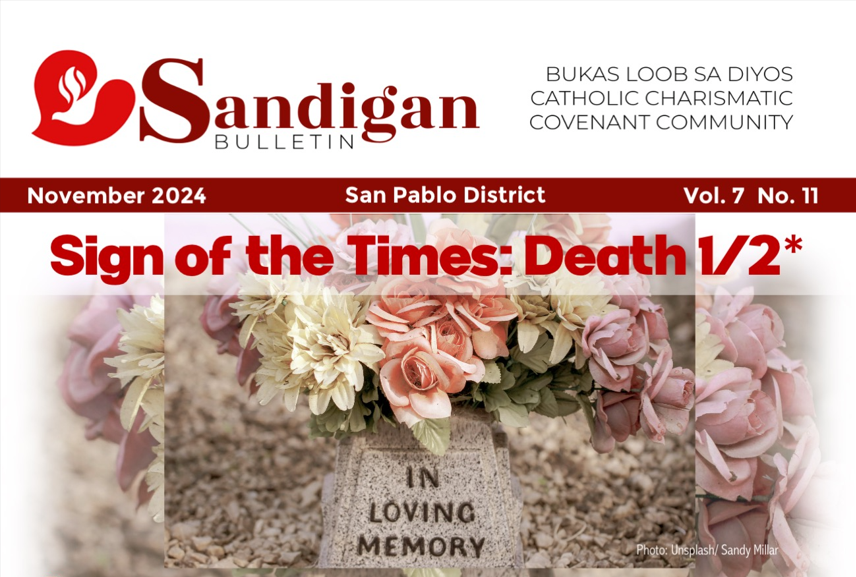

As we begin our journey toward the end of the liturgical year, let us ask ourselves: Have I really reflected on death? How do I understand death?
To help us with our reflection, let us begin with the definition of death in The Catechism: "Death is the end of man's earthly pilgrim- age, of the time of grace and mercy which God offers him so as to work out his earthly life in keeping with the divine plan, and to decide his ultimate destiny. When the 'single course of our earthly life' is completed, we shall not return to other earthly lives…"
.(Catechism of the Catholic Church, par 1013)
From this definition, we can highlight two points
- We affirm what we all know: Death is the end of life here on earth.
- Death is a signal that something is about to begin- incorruptible life. That in the fullness of time, God raises us up, and gives incorruptible life to our body, transformed by reunion with our soul.
How can we believe this, is this credible? Yes! We have Jesus, the source of our belief. He died on the cross and was buried by Joseph of Arimathea. His tomb was found empty by the female disciples, and the guards in the tomb reported all that had happened there to the chief priests, who then instructed them to lie about it.
He appeared to His disciples, and to many others, who testified that they had seen Jesus. Now we can understand why St. Paul said, “O death, where is your victory? O death, where is your sting?"
Because Jesus in His resurrection defeated death, and His incorruptible life is the life that God will offer to each of us after death.
Thus, we can be hopeful. The Catechism assures us, “Jesus, the Son of God, freely suffered death for us in complete and free submission to the will of God, His Father. By His death He has conquered death, and so opened the possibility of salvation to all men." (Catechism of the Catholic Church, par 1019)